
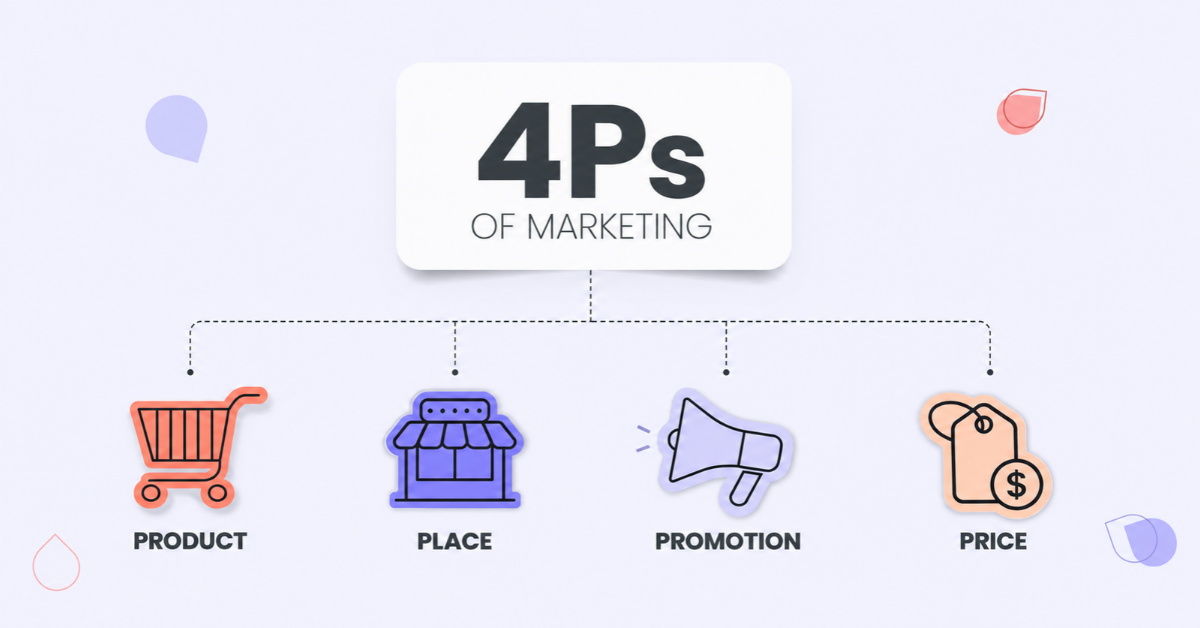
The aim of the 4 Ps of marketing is to drive the growth of a business with the four connected marketing decisions, which are product, price, place and promotion. These decisions determine what a business sells, how much money it can make, where customers will buy the goods, and how they will become aware of them. E. Jerome McCarthy developed and presented this model in 1960, and this was later popularized by Philip Kotler. It remains a useful checklist for marketers today to pinpoint problem areas. When growth stalls, one of the four Ps is usually out of line.
What Are the 4 Ps?
Each P answers one simple question. Product is the item or service on offer. Price is the amount customers pay. Place is where customers can buy. Promotion is how customers hear about the business.
A business controls all four. It cannot control the economy. It cannot control a rival’s ad budget. It can change its offer, its price, its sales channels, and its message. A vague goal like “get more customers” turns into four clear areas to check.
Product for Long-Term Growth
Product is the foundation of the offer. Quality, features, packaging, and warranty influence the customer’s perspective. These factors turn a one-time buyer into a loyal customer.
Many businesses describe features. Customers want solutions. Compare two descriptions of a watch. One lists “stainless steel, water-resistant, 40mm.” The other says “a durable watch you can wear to the gym and to work.” The second description answers a real need.
Try a simple test. Come up with one sentence that you could use to describe the product to a stranger. A long explanation signals confusion, and customers will feel the same. Cutting items also helps. Weak products drain time and money. Focusing on the best sellers often speeds up growth.
How Does Price Affect Business Growth?
Price does two jobs. It covers costs and leaves a profit. It also signals value.
A low price squeezes margins. It can also raise doubts about quality. New businesses often fall into this trap by copying the lowest rival. A high price needs proof of value. Without proof, sales slow down.
Three methods are common. Cost-plus pricing adds a margin to costs. Competitor-based pricing is set to meet the competition. Value-based pricing is based on the outcome the customer gets. Value-based pricing often supports the highest price, because it ties the price to the result the customer gets.
Discounts need care. They can feel like a quick win, but they can also teach customers to “wait for the next sale.” Margins can be better protected with a payment plan, bundle or small bonus service.
Value of Place
Place is about access. Customers should find the business easily. They should also buy without effort. For some businesses, a place is a storefront. For others it’s a website, a marketplace, or both. Marketplaces are great for adding reach; however, they also eat into the bottom line.
Place now includes search results and map listings. A large proportion of customers look at a company’s website first. Slow pages cost sales. A hidden contact button costs sales. A clumsy checkout costs sales.
A quick habit helps. Open the website on a phone. Try to buy something. Owners rarely do this. They usually view their own site on a desktop. The phone test often reveals problems fast.
Promotions Bring in the Right Customers
Promotion is the communication that informs people that the product is available. The goal is reaching people who are ready to buy.
Many businesses try five channels at once. They master none. Two channels used regularly beat five channels used occasionally. Choose channels which are already used by customers, such as social media or paid search ads. Monitor output for each. Drop channels that fail after a fair test.
Which P Should Come First?
All four P’s work together, but when you need quick wins, start with place. Even a strong product needs promotion for customers to understand its value. Wide distribution cannot rescue a weak product. It only spreads disappointment faster.
Fixes to place show results soonest. A faster checkout is one example. An updated local listing is another. Move to product and price next. Leave promotion for last. Advertising a weak offer wastes money. Real numbers should guide the final call.
The framework has one limit. It was built for physical goods. Service businesses often add people, process, and physical evidence. The result is called the 7 Ps. The original four still make the simplest starting point.
How Can Businesses Measure Results with the 4 Ps of Marketing?
Each P needs one or two numbers. Track repeat purchases, returns and reviews on products. Observe gross margin and conversion rates at various price levels when pricing. For place, check traffic by source and checkout completion. For promotion, track cost per lead, click-through rate, and which channel brings paying customers. Review the numbers monthly. A drop points to the P that needs attention. This habit prevents random changes.
Mistakes to Avoid
There are a few recurring errors. The first is looking at the framework as a one-off project. Costs change. Competitors change. Customer habits change. The mix needs regular reviews. The second is promoting too early. Ads cannot fix a weak product or a wrong price. The third is copying a competitor’s price. Their costs may look very different. The fourth is ignoring feedback. Customer comments often point to the weakest P.
Why Choose Us
JSA Global Communications has designed and developed websites for over 15 years. Our services include SEO, social media marketing, email marketing, web design, and Shopify development. We help with place (web design, local SEO, Google Business Profile) and promotion (SEO, PPC, social media, email). A Quality Assurance team oversees all stages of the project. More than 600 happy clients have worked with the team. All strategies are tailored to the client’s needs.
Conclusion
The 4 Ps of marketing support consistent business decisions. Product, price, place and promotion work together. Review each one, find the weakest, and fix it first. Monitor numbers on a monthly basis. Be flexible to change when the market requires it. Continuous progress on all four aspects gives a marketing plan that is a true growth driver. Ready to find your weakest P? Contact our team for a review.